
I was Audio Director on four PlayStation 2 games released between 2001 and 2006 — all were third-person games, in fantasy settings, and built with proprietary tools. This string of titles gave me and my team the chance to iterate on some really cutting-edge (for the time!) audio technology like advanced adaptive music, runtime Dolby Pro Logic II surround, and high-resolution streaming.
The Legend of Alon D'ar was released just one year after the PS2's American launch. Few third-party US titles were published this first year, as dev kits were scarce and the learning curve was steep. And we had a lot to learn.
This is the most poorly reviewed game I've ever worked on, and, alas, probably correctly so. I wrote some of the music for this title, and worked on some clever audio memory management strategies. But it just wasn't a great game.
However, some of the key technology we developed for it led straight into securing the Lord of the Rings game — and that was a rocket ship.
Lord of the Rings: The Two Towers was the first game tied to the film license (there was an unrelated Fellowship game not associated with the Peter Jackson films) -- The Two Towers game covers the events of the first two movies in the franchise. It was one of the top selling games of both 2002 and 2003, and critically acclaimed, too.
We developed what was at the time, I believe, the most sophisticated live-orchestral adaptive music system that had ever been attempted. We had access to all the music from the movie and a wide remit to edit and repurpose it as necessary. I was interviewed about it, and wrote articles for Gamasutra and GameSpy, as well.
To get an idea how we used it, check out this scene -- the Ringwraiths at Weathertop -- from the film, and then a little piece of this level from the game (sorry for the potato-cam game footage, this was PS2 analog capture):
The Weathertop scene in the Fellowship film.
Game state and cinematics informing music adaptivity in the game's Weathertop level.
Or here, creeping up the river in Fangorn Forest, where the music change is driven by game logic:
Music adapting to the game logic, Fangorn Forest level.
The game was nominated for "Outstanding Achievement in Sound Design" by AIAS, "Excellence in Audio" by IGDA, and "Sound Design of the Year" and "Best Use of Licensed Music," by GANG.
Forgotten Realms: Demon Stone, published by Atari, was clearly our successor to The Two Towers game in terms of gameplay, setting, and production style (though EA had taken the LotR license in-house).
Demon Stone was not a critical or commercial phenomenon like Two Towers, of course, but it did okay, and the sound was widely praised. In fact, the sound earned two BAFTA nominations, "Audio Achievement" and "Original Music!" It was also named a Sound and Vision Magazine "Home Theater Standout." Robb and I co-wrote a "Dev Diary" about the audio development for IGN.
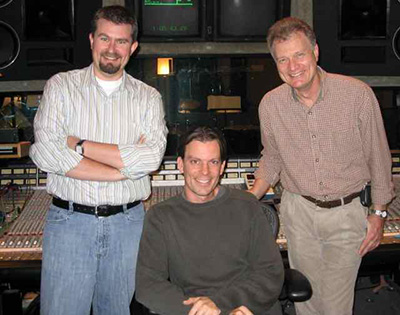
Me, Robb Mills (seated), Larry Kenton at Studio X.
We recorded Robb's all-original, live orchestral soundtrack at Studio X in Seattle, and implemented it in the next generation of our adaptive system developed from the Two Towers foundation.
Eragon was a deeply disappointing experience in many ways.
Suffice it to say, it was a tie-in to a movie that was troubled, and significantly delayed. The market changed dramatically under the feet of the game. And while Eragon was no ground breaker, it was a simple, fun little game with great production values (on PS2) that did not resonate with critics and just never found an audience.
We recorded Robb's all-original orchestral soundtrack at Paramount's Scoring Stage M, one of the classic rooms in Hollywood. The building would be demolished in 2008, but it was amazing to spend a few days in there. So much history.
Also, we popped some massive balloons in the space to grab an impulse response, which was actually really useful during the mix.
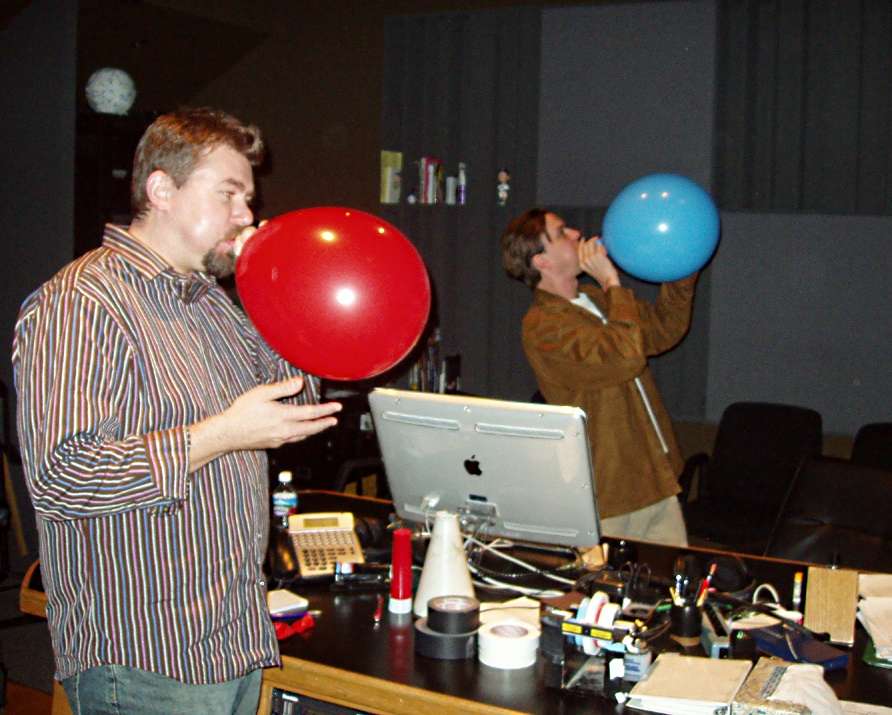
Inflating our impulses.
And for some reason we posed a picture of me pretending to yell at Robb. Perhaps a little comic relief in a stressful situation? Those sessions were spendy!
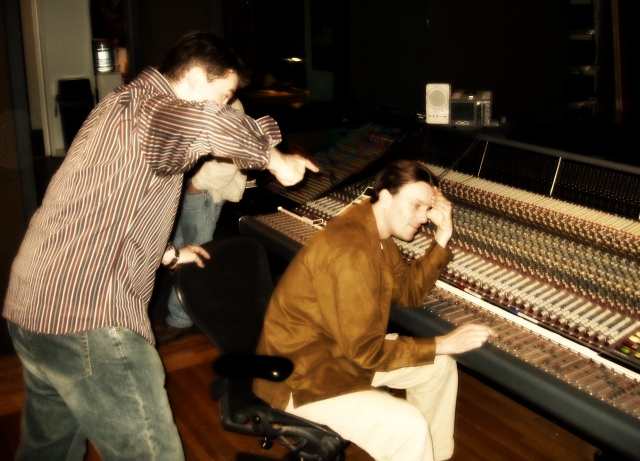
Why did we take this picture?
We recorded a "making of" movie about the sound, which literally includes the warning, "Professional sound engineers. Do not attempt at home." Classic.
We were so young!
In any event, with the introduction of the Xbox 360, this era was well and truly over. I actually left the company after this game was complete but before it hit the shelves, moving to EA's Redwood Shores studio to take over as Audio Director on The Godfather franchise.